There are plenty of resources on YouTube and the internet which shows how to tie a D-loop.
There is a convention to have the D-loop tied to the left side of the string at the top with the molten bulb away from the face, and to the right side with the molten bulb towards the face for the bottom, given the archer is right-handed. The reverse is suggested to a left-handed archer.
The D-loop should be tied in such a way that there’s a little bit of play when the bow is at rest. That bit of play will be taken up at full draw hence it needs to be sufficient to not create a pinching situation. The amount will differ with the pinch angle created in the string due to the axle-to-axle length of the bow, but about 0.5-1mm is suggested. This is typically about the height of two servings. It should not be too sloppy, allowing variable height at the back of the arrow whilst at full draw.
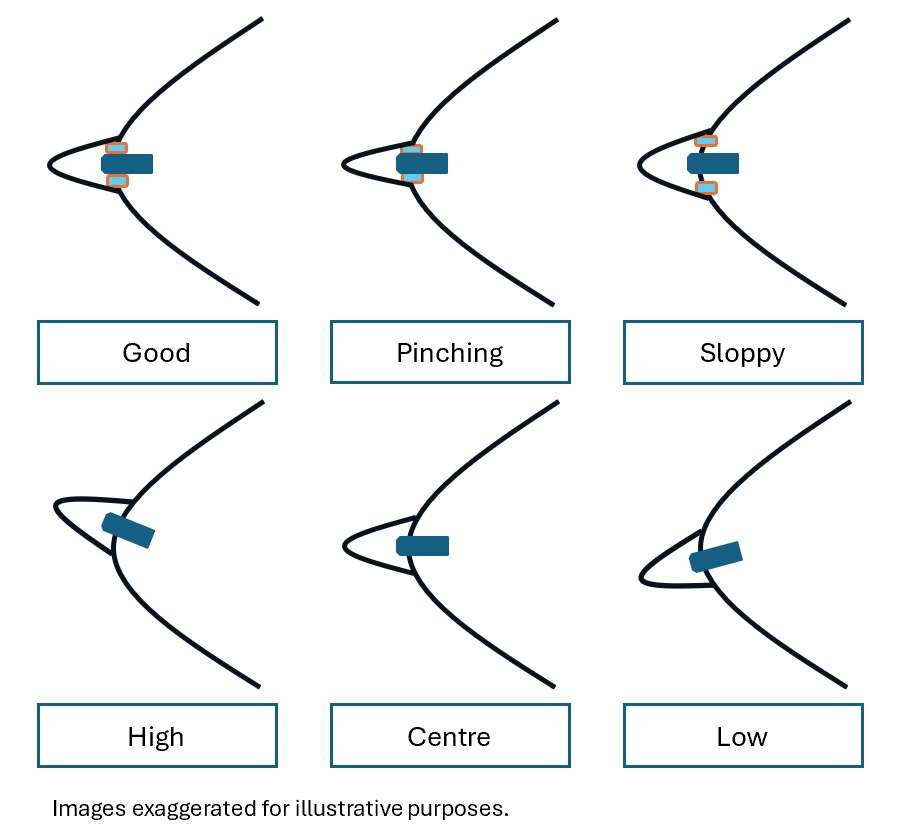
The height of the D-loop can also introduce pressure on the nock from the top or bottom if the height is too far off-centre. Pressure from the top can assist to keep the arrow on the rest, whereas upwards pressure can lift it off the rest when drawing. This lifting can cause the arrow to come off the rest or hang in mid-air.
A high D-loop will pull the bow above the horizontal line, holding high, and a low D-loop will pull the bow low. This assumes you changed the D-loop height after setting the timing with the D-loop at the perfect centre, aligned through the Burger holes.
The length of the d-loop influences the draw-length of the bow. Ensure it is tied consistently, and replacement lengths of D-loop rope are accurately prepared. It is suggested to have cut lengths with the one side melted and the loop position marked on the other. This way the D-loop can be tied down to the marked position, and the ball then melted into place.
An alternative is to have the D-loop pre-cut and melted, but this is only practical for D-loops over a certain length, with the length between the two melted balls being about 105mm or more. This would be quite a short d-loop.
Centre ties (soft nocks) help to alleviate knock pinch. It is recommended to have at least a bottom centre tie. These can be tied in one you’ve settled on the height of the D-loop. Soft nocks are also a great way to mark and retain the position of your nocking point for when you’re replacing a d-loop.
It is recommended to use two or three rotations of material for the top soft nock, and 5 or six for the bottom soft nock. This helps the keep the section of string between the D-loop knots square with the nock, which eliminates a huge amount of vertical grouping issues.