The scope and peep together provide the front and back alignment for aiming. The two items together influence how easy the sight picture is to acquire and maintain.
Peep & Scope Size
A smaller scope will limit your field of view but tend to be easy to align with the peep. A larger scope has a larger field of view, but it could rob a bit of accuracy if it’s more difficult to align to the peep due to the size.
The peep size relative to the scope housing is important for the alignment of the ability to align the concentric circles formed by the scope housing and the peep. When you move the sight closer to the riser it will appear larger relative to the peep, and when you move it away from the riser the opposite will occur, and it will appear smaller. This is a very important consideration when torque tuning your bow.
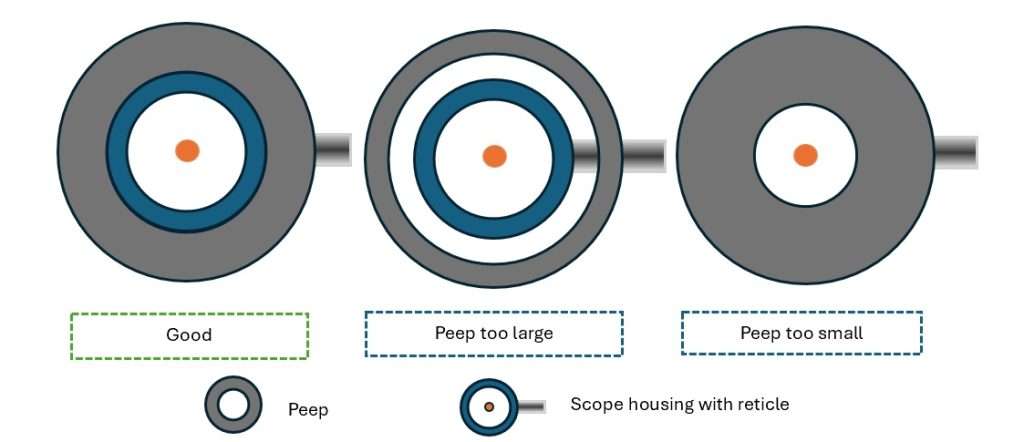
The distance between the peep and the archer’s eye also influences the choice of peep size, which is likely to be slightly larger the further the peep is from the eye due to the string angle. A taller bow relative to the archer will have the peep closer to the eye, whereas a shorter axle-to-axle bow will have the peep further away from the archer’s eye.
In low light conditions your pupils will expand, thus allowing additional light to enter the eye. This translates into you seeing more through your peep. The opposite happens when you’re in a very bright environment.
Peeps can also house a lens (rectifier/clarifier) to assist in clearing up the sight picture. It is important to have the target in focus, and the aiming point of reference visible, even if it’s blurred.
Lens
Lenses are available in various levels of magnification, from a clear lens with no magnification to 10x, mostly in increments of 2, but not always. This is an indicative value of the magnification of the lens, but is not accurate.
The choice of lens is based on the preference of the archer:
- Higher magnification increases the visible movement of the point of reference, which some archers find distracting.
- Lower magnification levels decrease the visible movement of the aiming point of reference.
As a result, higher magnification lenses are mostly suggested for archers who can hold the aiming point extremely still, with minimal float. More visible movement tends to increase anticipation of shots and the likeliness to succumb to target panic.
Actual vs Indicated Magnification
When looking at the lens, you often see a value such as 1.0, 0.75 or 0.5 on it. This is the dioptre value of the lens, which is a unit of refractive power.
The actual magnification is however determined by a combination of the dioptre, distance between the eye and the lens, as well as the clarifier or rectifier if present and installed in the peep.
An ideal system would be a convex lens with the right magnification but with a focal length of infinity, i.e., a lens with no focal point such that the light rays entering the eye are parallel and everything is in focus. This isn’t possible.
The higher dioptre the lens, the shorter the focal length, so what we try to do is use a clarifier to clear things up.
Clarifier
Clarifiers are a negative dioptre/concave lens. Thinking of the system in reverse, the negative dioptre being placed after the main lens effectively lengthens the focal length. This creates a more parallel light stream, thus resulting in a clearer picture.
Verifier
Verifiers are a positive dioptre/convex lens. It is not recommended to use these in conjunction with a strong scope lens as these will further shorten the focal length, resulting in a worse picture. The idea behind verifiers is that they act as a small correction for natural faults in the eye (long sightedness/hyperopia) whereby the eye focusses light behind the retina.